By TLex Frank Stalder, Officine Panerai R&D Director talks us through the new Submersible collection -
- which includes: PAM00614, PAM000615 and PAM00616 - released at SIHH 2015


By TLex Here’s a bit of jaw dropper from Officine Panerai’s 2015 collection unveiled at SIHH last week. The new Luminor 1950 Equation Of Time 8 Days Acciaio AKA PAM00516 is one of two new Special Editions created by them with one of the most classic and fascinating astronomical complications, the Equation of Time. P.2002/E Manufacture movement, hand-wound with a power reserve of eight days, which is displayed on an indicator on the P.2002’s back.

The history of time measurement arose from the human need to arrange events on a dimension which was not solely spatial and, since ancient times, man has found the answers to this need through the study of astronomy. The length of one day is derived from the period of one rotation of the Earth and the length of one year corresponds to the period of one revolution of the Earth around the Sun, and for centuries timepieces have been used to place events in a time-frame defined by these phenomena, establishing the universal convention which is time.

There is, however, a difference between convention and reality. Because of the elliptical orbit of the Earth round the Sun and the axial tilt of the Earth’s rotation in relation to the equator, the duration of a day measures exactly 24 hours on only four occasions in one year, while on all other days there is a difference between apparent time (solar time) and conventional time (mean time) which varies between being up to about 15 minutes ahead or behind, depending on the time of year.

This difference, the measurement of which is one of the classic complications of high quality watch-making, is called the “equation of time” and it is displayed by a linear indicator on the dial of the new Radiomir 1940 Equation of Time 8 Days and the Luminor 1950 Equation of Time 8 Days.

The inclusion of such a sophisticated complication as the equation of time does not alter the classic Panerai design of the two models, a design inspired directly by the history of the Florentine brand. One of the watches has the Radiomir 1940 case and the other the Luminor 1950 case, the latter being the historical evolution of the former, having the distinctive bridge device with clamping lever which protects the winding crown. Both cases are made of AISI 316L stainless steel – an alloy that is particularly resistant to corrosion – with a polished finish.

The dial of both models is black with the classic sandwich structure invented by Panerai in the late 1930s: two superimposed discs contain the luminous substance, the light of which emerges through the holes in it corresponding to the markers on the upper disc, providing a unique tonal depth and high legibility. As well as the linear indicator of the equation of time, the dial also contains the seconds counter at nine o’clock, the date window at three o’clock and the circular indicator on which the month can be read.

On the back of the case is a sapphire crystal window which enables the details and fine finish of the hitherto unissued P.2002/E movement to be admired. This is a development of the P.2002 caliber, the first to be made by Officine Panerai in 2005: it is a hand-wound movement with a diameter of 13¾ lignes, with three spring barrels providing the long power reserve of eight days which has been part of the tradition of the brand since the 1940s.

The Radiomir 1940 Equation of Time 8 Days (PAM00516) and the Luminor 1950 Equation of Time 8 Days (PAM00601) are two Special Editions of only 200 and 100 units respectively. Water-resistant to 10 bar (about 100 meters), they are fitted with an alligator strap, and the model with the Luminor 1950 case is supplied with a screwdriver and the tool for replacing the strap.
By TLex Yes, at 52mm this is a big boy, but thanks to its Titanium construction, the gorgeous new Mare Nostrum Ti AKA PAM00603 should still be pretty wearable (I’d certainly rock one). The Mare Nostrom in fact was first made by Officine Panerai in 1943 for the deck officers of the Royal Italian Navy and has been released as part of its 2015 Special Editions collection in a series of just 150 pieces.

The name ‘Mare Nostrum’ comes from Latin and means ‘Our Sea’, a reference to the Mediterranean sea from the times of the Roman Empire. Many centuries after; between 1941 and 1942, there was a short period when Italy spoke again of ‘Mare Nostrum’: this was during the Second World War, when the victorious missions of the Royal Italian Navy meant that for a short time a wide area of the Mediterranean Sea was controlled by the Italian fleet.

In 1943, the Panerai family created a chronograph for the deck officers of the Royal Italian Navy and called it ‘Mare Nostrum’, a name that had already been used by Guido Panerai in 1924 for what was likely the first Panerai chronograph. Sadly, all traces of this first chrono have been lost.

However a few prototypes of the 1943 chronograph do still exist; these were used so that the 2010 STEEL Mare Nostrum and the new Titanium version could be reconstructed with great technical accuracy and with similar aesthetic characteristics. The new Mare Nostrum Titanio is a Special Edition consisting of only 150 watches. It faithfully reproduces the 1943 model while updating it to the highest standards of today’s high-end watch-making and with some fundamental differences compared to the original.

The first difference compared to the vintage watch is the material from which the large 52mm in diameter case is made from. The metal used for the tonneau-shaped case is not steel but brushed Titanium, a material which combines excellent non-allergenic properties and greater lightness than steel with the structural toughness needed to resist high pressure, external stresses and corrosion.

The wide flat bezel, the screwdown caseback and the winding crown
engraved with the words ‘Mare Nostrum’ are all made of brushed Titanium.
Water-resistance is however is only 3 bars, the equivalent depth of
just 30 meters despite the structual toughness of Titanium mentioned before :(

The chronograph functions are controlled by two classic
chrono-pushers, also made of brushed Titanium, and the readings are
indicated by the central seconds hand and by a sub-minutes counter dial
at three o’clock. The continuous seconds hand rotates in a sub-dial at nine o’clock.

Protected by a Sapphire crystal with anti-reflective treatment, the
dial is made in two levels and, instead of the dark green of the vintage
model, it is a sophisticated tobacco brown, to match the
brown leather strap and its ecru stitching.

The new version of the Mare Nostrum has a hand-wound manufacture
movement: the OP XXV caliber developed on a Minerva 13-22 base; it is
12¾ lignes in diameter and has a balance wheel making 18,000 vibrations
per hour, like the Angelus movement of the vintage prototype. This is a
high quality watch-making caliber, hand-finished, with top-of-the-range
technical details such as the column wheel and the swan neck regulator.
The bridges are made of Maillechort, a nickel silver alloy that is
particularly hard to work, and they have a sophisticated Côtes de Genève
finish.
By TLex Finally a proper bonafide diving chrono from Panerai that isn't a regatta watch! It’s been a while since we saw a Submersible chronograph from Panerai; (to my knowledge) there hasn’t been one since the Luminor Submersible 1950 Chrono 1000m Slytech AKA PAM00202 from 2005 or the PAM 00187 from 2004.

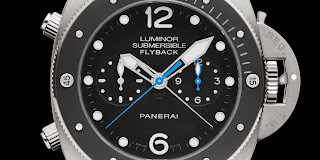
Introducing the new Luminor Submersible 1950 3 Days Chrono Flyback Automatic Titanio AKA PAM00615. PANERAI have released two new models with the Luminor 1950 case in brushed Titanium, which have an automatic chronograph caliber with flyback function. They are available with either a unidirectional rotational divers bezel in solid Titanium [PAM00614] or in Titanium with a black ceramic insert [PAM00615].
Many key innovations that have marked the history of the mechanical wristwatch were developed for the military during the first half of the last century. Requiring the highest possible quality from their instruments, the specialist forces that often employed them whilst operating in extreme conditions made use many of the functions that are, today found in luxury sports and divers watches.

The new Luminor Submersible 1950 3 Days Chrono Flyback Automatic Titanio from Officine Panerai brings together features which are military in their origins. They appear as two contemporary watches with a strong sporting characters and with great personalities and the purest Panerai identity.

As is the case with all Panerai models, the main point of reference is of course that of the sea. Professional underwater models that are water-resistant to a pressure of 30 bar ( an equivalent depth of about 300 meters), the new Luminor Submersible 1950 watches have a 47mm in diameter Luminor 1950 cases. The iconic design of the case, is immediately recognizable by its device protecting the winding crown whose historic origins go back to the model created by Officine Panerai in 1956 for the Egyptian Navy: the unidirectional rotating bezel for calculating dive-time.

Two versions of this are available: one with a bezel made entirely of brushed Titanium [PAM00614] and the other with a special bezel of Titanium to which a matte black ceramic insert has been applied, with linear markers and dots in titanium [PAM00615]. Both models are supplied with a black rubber strap, soft and durable, ideal for an underwater watch and personalized with the OP logo in Panerai blue.

The other function of the new Luminor Submersible 1950 originating from the military in the 1930s is that of the flyback chronograph. Also known as the ‘retour en vol’, this function enables the chronograph hand that is already moving to be zeroed and instantly restarted by a single pressure, without it being necessary first to stop the hand and then to return it to zero. In the Luminor Submersible 1950 the push button which controls the stopping and starting of the chronograph is at ten o’clock, while the push button at eight o’clock operates the flyback function and zeros the chronograph hand after it has been stopped.

To ensure the simplest and clearest possible reading, the chronograph minutes and seconds hands are both positioned centrally on the central dial and distinguished from each other by being different colors: the seconds hand is blue while the minute hand is rhodium plated, advancing instantaneously with a jump every sixty seconds. The colors chosen for the hands enhance the minimalist design of the black dial, with its dot-shaped hour markers and simple figures, and the small continuous seconds counter at nine o’clock. The two models have different elements at three o’clock: the model with the titanium bezel has the date window in this position while the model with ceramic bezel has the chronograph hour counter there.

The movement of the Luminor Submersible 1950is the P.9100 caliber, the first automatic chronograph caliber developed and made in the Panerai manufacture in Neuchâtel. Many details bear witness to its sophisticated construction: the vertical clutch, the column wheel, the two spring barrels connected in series which guarantee a power reserve of three days, the oscillating weight which winds the spring barrels as it moves in both directions, and the variable inertia balance which oscillates at 28,800 vibrations per hour.
To ensure the greatest accuracy when adjusting the watch, the mechanism has the device for stopping the balance wheel and the system which enables the hour hand to be moved backwards or forwards in jumps of precisely one hour, without interrupting the movement of the minute hand. The movement consists of 302 components and it is 13¾ lignes in diameter and 8.15 mm thick.

Both versions of the Luminor Submersible 1950 3 Days Chrono Flyback Automatic Titanio - 47mm are supplied with a spare strap, a screwdriver and the special tool for changing the strap.
By TLex Introducing the new Luminor Submersible 1950 3 Days Chrono Flyback Automatic Titanio AKA PAM00614. PANERAI have released two new models with the Luminor 1950 case in brushed Titanium, which have an automatic chronograph caliber with flyback function. They are available with either a unidirectional rotational divers bezel in solid Titanium [PAM00614] or in Titanium with a black ceramic insert [PAM00615].
Many key innovations that have marked the history of the mechanical wristwatch were developed for the military during the first half of the last century. Requiring the highest possible quality from their instruments, the specialist forces that often employed them whilst operating in extreme conditions made use many of the functions that are, today found in luxury sports and divers watches.

The new Luminor Submersible 1950 3 Days Chrono Flyback Automatic Titanio from Officine Panerai brings together features which are military in their origins. They appear as two contemporary watches with a strong sporting characters and with great personalities and the purest Panerai identity.

As is the case with all Panerai models, the main point of reference
is of course that of the sea. Professional underwater models that are
water-resistant to a pressure of 30 bar ( an equivalent depth of about
300 meters), the new Luminor Submersible 1950 watches have a 47mm in
diameter Luminor 1950 cases. The iconic design of the case, is
immediately recognizable by its device protecting the winding crown
whose historic origins go back to the model created by Officine Panerai
in 1956 for the Egyptian Navy: the unidirectional rotating bezel for
calculating dive-time.

Two versions of this are available: one with a bezel made entirely of
brushed Titanium (PAM00614) and the other with a special bezel of
Titanium to which a matte black ceramic insert has been applied, with
linear markers and dots in titanium (PAM00615). Both models are supplied
with a black rubber strap, soft and durable, ideal for an underwater
watch and personalized with the OP logo in Panerai blue.

The other function of the new Luminor Submersible 1950 originating
from the military in the 1930s is that of the flyback chronograph. Also
known as the ‘retour en vol’, this function enables the chronograph hand
that is already moving to be zeroed and instantly restarted by a single
pressure, without it being necessary first to stop the hand and then to
return it to zero. In the Luminor Submersible 1950 the push button
which controls the stopping and starting of the chronograph is at ten
o’clock, while the push button at eight o’clock operates the flyback
function and zeros the chronograph hand after it has been stopped.

To ensure the simplest and clearest possible reading, the chronograph
minutes and seconds hands are both positioned centrally on the central
dial and distinguished from each other by being different colors: the
seconds hand is blue while the minute hand is rhodium plated, advancing
instantaneously with a jump every sixty seconds. The colors chosen for
the hands enhance the minimalist design of the black dial, with its
dot-shaped hour markers and simple figures, and the small continuous
seconds counter at nine o’clock. The two models have different elements
at three o’clock: the model with the titanium bezel has the date window
in this position while the model with ceramic bezel has the chronograph
hour counter there.

The movement of the Luminor Submersible 1950is the P.9100 caliber,
the first automatic chronograph caliber developed and made in the
Panerai manufacture in Neuchâtel. Many details bear witness to its
sophisticated construction: the vertical clutch, the column wheel, the
two spring barrels connected in series which guarantee a power reserve
of three days, the oscillating weight which winds the spring barrels as
it moves in both directions, and the variable inertia balance which
oscillates at 28,800 vibrations per hour.
To ensure the greatest accuracy when adjusting the watch, the mechanism has the device for stopping the balance wheel and the system which enables the hour hand to be moved backwards or forwards in jumps of precisely one hour, without interrupting the movement of the minute hand. The movement consists of 302 components and it is 13¾ lignes in diameter and 8.15 mm thick.

Both versions of the Luminor Submersible 1950 3 Days Chrono Flyback Automatic Titanio - 47mm are supplied with a spare strap, a screwdriver and the special tool for changing the strap.
By TLex Last year IWC wowed us with a stunning new AQUATIMER collection, this year it is fellow Richemont Group favorite, Officine Panerai who have taken to the sea with a stunning new Submersible collection lunched a SIHH 2015 in Geneva, today.
Sadly there wasn't the reissue of the 1980s Mille Metri that I had hope for, but Panerai have nevertheless excelled themselves – and for me the standout model has to be the new Luminor Submersible 1950 Carbotech™ 3 Days Automatic AKA PAM00616, which epitomizes the popular marriage between modern and vintage. With its cutting-edge Carbotech case, it calls into question the use of traditional metals such as steel. Surely this is the future (the here and now) of the modern mechanical dive watch!

Each and every new Luminor Submersible 1950 Carbotech™ is unique and different from the others thanks to the technical and aesthetic characteristics of Carbotech, a new composite material which is making its debut in high-end watch-making with Officine Panerai.
One of Panerai’s greatest assets in watch-design is its ability to draw upon a fantastic military diving heritage to combine notes from its past with the latest in watch-making trends and innovations. In 2011, they wowed us with a Luminor Submersible that for the first time had a case made of BRONZO, an ancient material with unmistakable nautical connection, personalized by ageing with the passage of time.

Today, Officine Panerai’s Workshop of Ideas has its eye firmly fixed on the present and future with a remarkable new technical case material that has been used for the Luminor Submersible 1950 Carbotech™. Carbotech, a composite material based on carbon fiber has never before been used in the watch-making. I’m pretty sure there are similar carbon-based composite cases on the market such as LW’s new CARBON, but this is a first. As well as providing exceptional technical performance, carbotech has an uneven, matt black appearance, which when cut results in an example that is unique.

The structure of carbotech is designed to enhance both the aesthetics and the performance of the material. It has been used to make the case, the rotational divers bezel and the Panerai’s trademark lever bridge which protects the winding crown. To form the plates of carbotech from which these components are made, thin sheets of carbon fibers are compressed at a controlled temperature under high-pressure together with a high-end polymer known as PEEK (Polyether Ether Ketone) thus binding the composite material so that it is even stronger and more durable.

The carbon fiber strands that are used are very long, so as to ensure great aesthetic uniformity, the sheets are superimposed and pressed together in such a way that the fibers of each layer are set at a different angle to the ones above and below. With this structure, the mechanical properties of carbotech are much higher than those of similar materials or of other materials used in the world of watch-making, such as ceramics and titanium: carbotech is lighter than these and much more resistant to external solicitations, as well as being hypoallergenic and not subject to corrosion.
While the watch’s case material might be futuristic, every other design detail of the watch is faithfully inspired by the brand’s history.

The Luminor 1950 47mm case was developed by Panerai in the late 1940s to be worn on the wrists of commandos of the Italian Navy. It is fitted with a divers bezel with its markers consisting of small studs, inspired by the legendary Egiziano that was made for the Egyptian Navy in 1956. The bezel rotates only anticlockwise and enables dive-time to be calculated: a useful function for a professional divers instrument which has been WR tested to 30 bar, the equivalent of 300 meters.

The dial of the new Luminor Submersible 1950 Carbotech™ is black with applied hour markers, the date window is at three o'clock and the sub-seconds counter marked by Panerai blue details is at nine o'clock. The screwdown caseback, which helps to ensure the watch’s water-resistance, is made of Titanium with a black DLC treatment. It is engraved with elements characteristic of the Panerai brand: “Florence 1860”, the city and year of birth of Panerai watchmaking, and the image of a Slow Speed Torpedo (SLC), the notorious "pig" on which in the 1940s the commandos of the Italian Navy sailed through the depths of the sea on their missions while wearing instruments made by Panerai.

At the mechanical heart of the Luminor Submersible 1950 Carbotech™ is the P.9000 automatic caliber, developed in-house by the Officine Panerai manufacture in Neuchâtel. The movement, 13¾ lignes in diameter, has two spring barrels giving a power reserve of three days, and the oscillating weight rotates in both directions. To ensure accuracy when setting the time, the movement has the device which stops the balance wheel while the hour hand moves forward or backward in increments of one hour, without interfering with the progress of the minute hand. The oscillation frequency of the balance is 28,800 vibrations per hour.

The new Luminor Submersible 1950 Carbotech™ is fitted with a black rubber strap, personalized for the first time by the OP logo in Panerai blue.
By TLex Blancpain have unveiled a special stunning blue version of their Bathyscaphe Chronographe FLYBACK as part of a series of Limited Edition Ocean Commitment watches, of which it is the first model.

The Bathyscaphe name is a model steeped in the brand’s history. Three years after the 1953 release of the original Fifty Fathoms, Blancpain introduced it as a sort of little brother, smaller in diameter so that that it could be worn not just for diving but as a daily wearer.
Just like the Fifty Fathoms, the Bathyscaphe has evolved over the years becoming a part of the Fifty Fathoms legend. No tribute could be more fitting for the Bathyscaphe Chronographe Flyback than being the debut model of the Ocean Commitment series.

Despite 60 years of the Fifty Fathoms influences, the Ocean Commitment Bathyscaphe Chronographe flyback is a cutting-edge mechanical diver, powered by Blancpain’s latest in-house Manufacture movement, the F385.
Running at a high frequency of 5 HZ – 36'000vph, the entirely new column wheel controlled Flyback Chronograph movement is ideal for timing, as each second is perfectly divided into 1/10th of a second intervals.

As well as this, the F385 caliber makes use of silicon for its balance wheel spring. And because silicon is anti-magnetic, its use provides the same degree of protection from magnetic fields as dive watches that rely on a Faraday cage (soft iron inner case).
One of benefit of the F385’silicon technology over a traditional anti-magnetic housing is that you are able to see the watch’s movement in all its glory through a Sapphire crystal exhibition caseback; whereas before it would be impossible to do this.

Two important divers features of the watch include: sealed chronograph pushers that allow use of the chronograph during dives up to a depth of 300 meters. And a flyback function with just one push to stop the first event, a second to return to zero and a third to start the second event - greatly simplifying chrono operations. A single push of the return to zero pusher stops the first event, returns the timers to zero and restarts the timing for the second event. This is particularly useful for divers' decompression stops.

The watch is housed in a 43mm grey ceramic case, with a ceramic crown and ceramic chronograph pushers and a unidirectional blue ceramic rotational divers bezel with liquid metal dive-time indications. The blue color theme is carried over to the dial, which offers three sub-dials for the chronograph counters and small seconds display.

On the back of the watch, the movement and winding rotor are visible through the clear caseback. The winding rotor has been specially decorated for this Limited Series bearing the logo for the Ocean Commitment.

Purchasers of the watches will join the Ocean Commitment ‘circle’ contributing to Blancpain's support for oceanic environmental causes through a 1000euro donation made by Blancpain and coming from the sales revenue made on each of them.

Each Ocean Commitment Bathyscaphe Chronograph Flyback will be individually numbered. In addition, each purchaser of one of these Limited Edition timepieces will receive a copy of Blancpain’s collectible volume entitled Fifty Fathoms The Dive and Watch History 1953-2013. The copy received by each purchaser will be hand numbered to correspond to the serial number of his watch.


