Showing posts with label ARTICLES. Show all posts

2024-12-14

AQUASTAR: Traditional Swiss Diving Tools [where tradition meets innovation]

AQUASTAR, once pioneer of the diving watch industry, has resurfaced to reclaim its throne as a bastion of traditional Swiss (tool) watchmaking, seamlessly blending history with modern innovation. Since their renaissance, Aquastar has been diligently reestablishing itself as one of the most consequential names in traditional Swiss diver's watches. Originally technical innovators and early pioneers in the diving watch industry, Aquastar timepieces were sold as indispensable diving instruments alongside scuba diving equipment. To divers, these watches were perhaps as vital as the breathing apparatus that they were sold alongside. As far removed from the glittering display cabinets of luxury retailers as hammers and chisels were. They were actual tools, not in name alone. Today, the modern-day Aquastar has firmly planted itself in the collectors' and enthusiasts' market. It straddles the world of high-end Swiss watchmaking and the hugely popular retro-tool-watch space, competing with household names like Tudor and Oris, as well as the burgeoning micro-brand space. Yet, this historic mark strives to set itself apart, striking the balance between high-end luxury and rugged utilitarian Swiss watchmaking, and with a reasonable price point to boot, made even more reasonable when pre-order pricing is taken advantage of. Under the stewardship of Rick Marei, a dive watch historian and the modern-day skipper of Aquastar, the brand has already brought to market several fan favorites from their extensive historical archives.

Marei, with his almost Midas-like touch for bygone-era diver's watches, has been responsible for the resurrection of Aquastar, Aquadive, Doxa, Jenny, and Synchron, as well as the famous ISOfrane and Tropic strap companies.


Some of Aquastar’s standout features include: a Diver's Bezel with a Military No-Decompression Table: as seen on the Deepstar Re-Edition. And a Minute-Creeper Elapsed Dive Time Indicator: as found on the Benthos 500 Founder’s Edition.

Meanwhile Aquastar has remained true to its identity. Iconic models like the Deepstar with its striking monocompax (big eye) chronograph counter, the Model 60 and the Benthos 500 have rekindled a dormant flame in the hearts of enthusiasts, world over. 


While their current lineup employs the latest materials and manufacturing techniques and in some instances even manufacture calibers, they seldom deviate from their archives, methodically working through their historic designs, leaving their loyal following wondering with bated breath what will come next.

And rather than being swayed by the latest trends, they could themselves be considered trend-setters. If we are to look at what lies at the very core of the collectors’ market, the popular retro vintage tool diver, it was in fact Doxa under Rick Marei that was largely responsible for the resurgence and repolarization of this enduring trend. If you are new to the Aquastar brand, but familiar with Doxa, or Tudor's Black Bay, or even the Oris Divers’ Sixty-Five and the like, know this, that we have Rick Marie to thank, one of the earliest proponents of these popular retrospective vintage designs. As a traditional Swiss independent brand that once stood at the forefront of technical innovation, we can look forward to Aquastar continuing to lean into their traditional technical roots, perhaps even exploring modern case materials such as Grade 5 Titanium or composite materials. Reflecting on their early adoption of 904L Steel and the use of fiberglass for the Glasstar, innovation is embedded in their DNA.

Currently Aquastar offers an impressive range of divers, the BENTHOS 500 FOUNDERS EDITION, the DEEPSTAR II POLARSTAR & the AIRSTAR models are their newest editions to the lineup.  

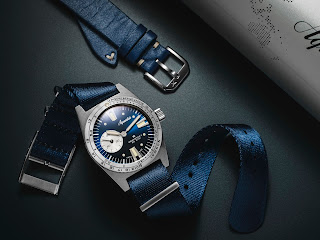
In addition to those, Aquastar has just launched the NEW Benthos H1 BLUE EDITION.


2021-02-22

IANOS Avyssos

Here’s something very cool to kick the week off – a new Swiss made diver with an ancient Greek soul or perhaps we could say a Greek diver with a modern Swiss heart beating within, or is it modern (the beating heart that is)? 

Introducing the Ianos Avyssos (Greek for Abyss), a new diver’s watch that combines the brand’s two major inspirations on its unique dial: the Antikythera Mechanism and Kampanelopetra.

Discovered on a sunken Roman-era shipwreck near Antikythera Island in the Aegean Sea, the Antikythera Mechanism is an ancient Greek hand-powered orrery (model of our solar system) thought to be the first analogue computer used to predict astronomical positions and eclipses for calendar and astrological purposes, decades in advance. 

Ianos have drawn inspiration from this highly complex ancient mechanism to create the watch’s movement indictor found on the dial at the 6 o’clock position.

A requirement of any diver’s watch adhering to industry norms for diver’s watches is to be able to show that its movement is indeed operating – 

this can be done with a traditional seconds hand or in this instance a rotating disc with a design that echoes that of a 2000 year old mechanism.

The legendary Kampanelopetra is an ancient diving technique used by Greek sponge divers. 

The Symian sponge divers and the Kampanelopetra technique through the legendary dive of Stathis Hatzis, Greek freediving history spans millennia.

Paying homage to the sponge divers who found the Antikythera wreck and their ancient heritage, Ianos have incorporated the iconic Kampanelopetra design into the dial as hour markers, a symbol of the divers' unbreakable spirit in the face of daily danger and adversity. Furthermore, in order to accentuate this ancient diving technique and the age of the Antikythera mechanism, the dial has been texturized with a sandpaper-like finish to give the watch a more used and vintage feel in line with classic vintage divers, the numbers and minute indicators have been cut-out to create a sandwich dial.

Meanwhile the body of the Avyssos is every bit as intriguing as its face. 

The 44mm in diameter Stainless steel case is fitted with a scratch proof Sapphire crystal, a steel diver’s bezel with engraved dive-time scale as well as screw-down crown. The case is water-resistant to a depth of 300 meters.

The bezel features a screw-like design to define the watch's functional utility and provide better grip in and out of water while the case itself has been thoroughly thought out and designed from the ground up. 

Its slightly curved shape hugs the wrist while its slanted sides provide a slimmer profile that looks and feels much smaller than it is.

Aiming to enable functionality, utility and comfort, the case-back features a deep channel in which a NATO strap can be passed through and concealed. This way, the need for springbar tools is totally eliminated. As continuation of the watch’s inspiration, the Avyssos features an open case-back with a circular window mirroring the design of the Antikythera sub-seconds mechanism through which the balance wheel can be seen. And finally that modern Swiss heart I was talking about is in fact is not so modern after all as it relies on a good old fashion hand-wound system. The Sellita SW 216-1 mechanical manual wound movement comes with 42hrs of power-reserve.

Thoughts? This is a diver that respectfully follows all the codes of dive watch design minus all the tedium that tends to come along with that. 

Because dive watches are characterized (in fact so often judged) on the legibility of their dials – they can get a bit boring but the Avyssos adds intrigue with its clever use of textures evoking the ocean - 

not in a predictable way with wave patterns and such – you truly get a sense of ancient Greek sponge divers from it and that’s very cool.

Also only a few new diver’s watches come up on my radar that immediately elitist such an emotive response – mine was “that’s pretty damn cool” which is usually followed “that’s pretty damn expensive” only with its list price of 1’000CHF, the Avyssos is in fact pretty damn reasonable. 

The hand-cranked movement was unexpected but, again it adds interest to the watch and is very much in keeping with the overall theme of the watch. In summary, to coin a word taken directly from Greek – kudos!

2020-12-21

Squale x AWCo SUBINO & NO RADIOBINO Limited Editions

You know how they say “don’t shoot the messenger”? Well in this case the messenger is me and yeah, you should go right ahead and blimmin’ shoot me cos’ I’m as late to this party as a very late man who’s missed the boat heading to his own funeral – actually I should probably just shoot myself. 

But they also say that you shouldn’t cry over spilt milk either, so chin up and let’s see what the heck we just missed out on and remember there’s always the secondary market, and if you read on you might even discover some light at the end of the tunnel.

Introducing the Subino & No Radiobino, a pair of ultra-rare Squale x AWCo Special Editions watches steeped in dive watch lore. AWCo btw is the Amsterdam Watch Co. 

while Subino & No Radiobino sounding more like the names of the host and show-name of the Italian version of the Wiggles refers to these two very awesome Squale divers that are equipped with NOS Blancpain Fifty Fathoms cases from the 50s.

I’m not sure if Squale CEO Andrea Maggi (who btw I have met a couple of times and is a very nice chap) was having a bit of clear out or was rummaging through some of his old inventory from Squale but he struck upon gold when he uncovered 180x NOS (new old stock) FF case from the 1950s. 

One of Squale’s more interesting claims to fame is that once upon a time they supplied watch cases under the Von Büren name to other legendary Swiss dive watchmakers such as Doxa, Heuer and indeed Blancpain with whom the boutique dive watchmaker had a longstanding relationship with.

For instance Blancpain’s 1970s Fifty Fathoms Bund used the exact same case that Squale’s current 1521 is equipped with. 

There are even Blancpain models with the Squale logo at 6 o’clock on their dials as well as the Von Büren mark on their case-backs to signify who the case manufacturer was. 

The earliest Squale FF’s cases date back to the 1960s; this particular batch of cases came via a company that used to assemble watches for Blancpain. 

The cases which were apparently in mint condition were originally used for Blancpain’s MC4 diver’s watch as well as the Waltham-branded variant.

Squale even managed to track down the original patent filed for this case design, and it was signed by Jean-Jacques Fiechter, no less, the very same inventor of the diver’s bezel and water-tightness indicator as found on the (recently featured) FF MIL-SPEC who was co-manager of Blancpain from 1950 until 1980. 

The patent was filed in 1954/55 and granted in 1959, dating the case’s actual development to the early fifties. The patent shows a design for a waterproof dive watch case with a friction-based bidirectional rotating dive-time bezel and a rather special case-back.

It is made up of two separate components; the actual cover and a surrounding ring that holds it in place. 

The patent document itself is a charming piece of history, from a time when legal-jargon was not nearly as oversused as it is today. It is said to be very readable and perfectly understandable – yes, even for OceanicTime’s editor. 

Another interesting feature of the cases which were even equipped with the original acrylic bezel inlays with cream-colored triangular 12hr markers, is a tiny sign on the inside of their case-backs, reading Rayville SA.

When the company was sold outside of the Blancpain family in 1932, it had to change its name. At the time it was Swiss law that a family name could no longer be maintained when selling a business. 

The new owners took the name of the village where the brand came from, Villeret and rearranged the letters to create a name with a more international-appealing ring to it - Rayville. 

So that’ the history - now to the two new (now SOLD OUT) models that were lucky enough to have been bestowed with the honor of being based on such an historic diver’s watch case.

Limited to 60 pieces, the first model, nicknamed SUBINO, Italian for little sub (aww so cute) is a nod to the current Italian ownership of Squale and the modest, vintage-feeling case-size of the watch. 

It is powered by a reliable ETA 2671 movement. This smaller version of ETA’s well-known caliber allows for the implementation of a rotor. 

This means an automatic caliber could be fitted into a case that was originally designed for a flat hand-wound movement.

The dial features a 3-6-9-12 dial layout with clean painted stick markers in between. The indices are executed in modern Super-LumiNova C3, in a shade that balances with the original Blancpain bezel inlay. 

There is a closed seconds track around the matte black dial, optically divided into four sectors with subtle triangles at 3, 6, 9 and 12. The AWCO name can be seen in red.

The handset is another nod to the early dive watch era. The same pencil style hands you would find on a Blancpain diver from the time were chosen. 

The second model the NO RADIOBINO (also limited to 60 pieces) is another nod to early dive watch history. 

The original Fifty Fathoms was adopted by the French Navy as a tool for their Special Forces frogmen. These watches featured large amounts of radio-active Radium lume for optimal under-water visibility.

When a civilian version of these watches was introduced, it featured this distinctive yellow and red NO RADIATIONS symbol on its dial, indicating the absence of harmful Radium. 

Its matte black dial features diamond, stick and dot indices, characteristic of dive watches of the day. The same pencil-style hands are once again used as well as the same automatic ETA movement as the Subino.

The No Radiobino comes on another piece of dive watch history: a NOS steel flat-link Squale bracelet from the 1980s.

Thoughts? 

Measuring a mere 34.8mm in diameter these truly remarkable diver's watches are not only cute of name but are cute in stature however in terms of the sheer amount of history and provenance that they come with surly allow them stand head and shoulders above many of their contemporaries. 

Btw you don’t need to be a mathematician to have realized that there are still x60 FF cases from the 180, that are an accounted for – stay tuned!

2020-10-20

OLLECH & WAJS Caribbean 1000 & GLOBAL MARINE Inc.

The humble spring bar; made from Stainless steel, mere millimeters in length; these tiny little bars are all that separates you and your treasured diver’s watch from an eternity on the ocean’s bed. 

This is the story of how the World’s best deep-water engineering company helped improve Ollech & Wajs’ spring bars. All content, below is courtesy of Ollech & Wajs’ Vincent Fremont. Many thanks for sharing this fascinating story with us. 

Btw, included among the photos are some of the O& W Astro-Chron ref. 2003 similar to the model tested by the Global Marine dive team.

If the name Global Marine Inc. sounds familiar, it’s probably because of its controversial involvement in the Central Intelligence Agency’s $500 million attempt, in the early 1970s, to raise a Soviet submarine off the floor of the Pacific Ocean. 

The audacious mission, to recover K-129 along with its nuclear missiles, cryptographic equipment and code books from a crash site almost three miles beneath the surface, is said to be the CIA’s most daring covert intelligence-gathering operation ever. 

It was certainly the greatest-ever feat of deep-water engineering. But the story of Global Marine Inc. goes far beyond its Cold War salvage work.

The US-based company was one of the early pioneers of offshore drilling and, in the late 1950s, developed the technology to drill at greater depths than had previously been thought possible. 

While other firms worked on shallow-water jackup rigs, Global invented the technique of using ship-mounted drilling rigs to explore previously unreachable parts of the ocean bed for oil and natural gas.

It soon became the king of the deep-water drilling, and by the mid-1960s, Global Marine Inc. was one of the world’s biggest offshore drilling firms, with rigs off the coasts of Alaska, Nigeria, Australia, Libya, California, and Louisiana, and in the Persian Gulf and the North Sea. 

It was not an oil or gas company and did not sell either commodity, but it rented its rigs and crews to oil and gas companies for offshore drilling.

Global Marine’s expertise lay in sophisticated engineering and innovation, and the company was continuously exploring new ways to utilize its skills and equipment. 

With its core business prospering, Global diversified into related fields, taking on contracts from a variety of business, scientific and educational institutions involved in oceanographic and geological exploration. 

The US government also made use of Global’s unparalleled extreme deep-water expertise, earning it contracts from the National Science Foundation, the US Navy and various federal agencies, including the CIA.

Global Marine’s technology and expertise was being used not only to harvest the ocean’s resources but also to further understanding and knowledge of the planet. 

One such project it undertook was an unprecedented worldwide geological survey of the seabed. A purpose-built deep-sea research and scientific drilling vessel, called the Glomar Challenger, took core samples from the ocean floor, some of which was up to 16,000 feet deep. 

The data collected allowed major advances in the theories of plate tectonics and provided evidence of continental drift. Each Global Marine drill ship had its own specialist dive team ready to go into the water any time day or night.

By 1967, Global Marine Inc had recruited entire teams of geologists and geophysicists, and had set up an ‘oceanics division’. It was around this time that Ollech & Wajs invited Global Marine to evaluate its watches for use in extreme deep-water environments. 

O&W had earnt a reputation for its professional-grade, high-performance dive watches but now wanted to expose their watches to conditions that could not be simulated in a lab. 

Bob Howard, a diving supervisor with the oceanics division, was assigned the task. Bob coordinated dive support teams for Global Marine’s twelve offshore drill ships and, like many oil field divers of the day, was ex-military.

Bob had an athletic physique, forged by years of toiling with the relentless force of the ocean, invariably laden with heavy equipment. One ex-colleague described him as "an impressive specimen”. 

He thrived on the challenge of venturing where others would not dare and was often called upon to do so at any time of the day of night. 

The two Ollech & Wajs models to be field-tested were the Caribbean Precision 1000 ref: 702 and the Astro-Chron diver’s chronograph ref: 2003. Over a four-month period, the watches accompanied Bob and his team to some of the most challenging ocean environments in the world, clocking up hundreds of hours under water.

From the North Atlantic to the Arabian Gulf, the watches were subjected to depths of up to 400 feet and radical temperature and ambient pressure changes, including periods in decompression chambers. 

Wherever the divers went, the watches went too, and they suffered the daily abuse of commercial diving activities, with no special effort made to pamper them. 

Aside from some inevitable scoring to the Plexiglas crystals, both watches gave excellent service and evidenced no mechanical malfunction at all throughout the four-month test period. 

Bob, who personally wore the O&W Astro-Chron on 63 field diving operations, conceded in his report on March 6th 1968 : “Both watches functioned far beyond our expectations”.

The test findings were not, however, entirely faultless. During a routine dive, two weeks before the trials were completed, the Caribbean 1000’s strap became disconnected from the case and the watch was lost. 

Due to the depth and time limitation of the dive, no attempt to recover the watch could be made, but the most likely explanation was  a failed spring bar. 

While the loss of a test watch is always regrettable, its sacrifice was not in vain. Ollech & Wajs learnt a valuable lesson from the lost Caribbean — even a dive watch with a 1,000m depth rating is only as reliable as its weakest component. This was a basic engineering principle the experts at Global Marine Inc. knew only too well.

No doubt O&W had some stern words on the matter for the spring bar supplier—there is certainly no record of another ref: 702, or any other dive watch, being lost at sea. The incident also affirmed O&W’s belief in the process of iterative testing. 

The Global Marine team were nonetheless satisfied with the performance of both watches, and Mr. Howard emphatically concluded his report with the following endorsement: 

“I would be most happy to recommend these watches to anyone interested in purchasing a reliable piece of diving apparatus”.

The fate of the missing Caribbean 1000 remains a mystery. There is a possibility it still lies undisturbed in the same murky spot where it fell, well beyond the reach of daylight, entombed under decades of sediment—a permanent testament to one of the most celebrated dive watches of its era. 

However, an ex–Global Marine colleague of Bob’s, named John Hollett, has his own theory: 

“A lost watch in deep water is exactly the kind of thing that Bob would have considered a professional and personal challenge. My bet is that at the very next opportunity he’d have geared up and gone right back down for it”.

 https://ow-watch.ch/

OceanicTime Archives